Investment Casting (Lost Wax Casting) is one of the most precise metal casting technologies today, capable of creating complex components with smooth surfaces and dimensional tolerances as tight as $\pm$0.05–0.1 mm, often eliminating the need for secondary machining. This technology is widely utilized in marine (propellers), gas appliances, automotive, plumbing, and medical industries.
Based on the operational excellence at CDL LOST WAX CASTING JOINT STOCK COMPANY (ISO 9001:2015 certified, 60-ton/month capacity), we present a comprehensive analysis of the 10-step process.
Step 1: Wax Injection
Metal molds are engineered according to the client’s 3D drawings ($\pm$0.02 mm tolerance). Wax is injected at 60–70°C and 0.5–1.5 MPa pressure. The patterns are immediately quenched in cold water ($\leq$ 5s) to prevent thermal deformation.
- Key Control: Avoid overheating the wax to prevent post-cast shrinkage. Minimum wall thickness: 0.8–1.2 mm.
Step 2: Shell Building (Ceramic Coating)
This step determines the mold’s structural integrity. The process involves 12–15 layers:
- Prime Coat: Fine slurry + Zircon sand (0.8–1 mm thick).
- Intermediate & Backup Layers: Coarse slurry + Silica sand.
- Drying: 2–4 hours per layer at 50–60% humidity.
- Total shell thickness: 8–12 mm.
Step 3: Dewaxing
The shells are placed in a steam autoclave at 150–180°C and 6–8 bar for 15–20 minutes. 95–98% of the wax is reclaimed and recycled.
- Key Control: Insufficient time leaves wax residue (causing inclusions); excessive time risks shell cracking.
Step 4: Burnout / Pre-heating
Empty shells are fired in a kiln at 1000–1250°C for 35–60 minutes to remove trace wax and strengthen the ceramic bond.
- Key Control: Temperature must be maintained within $\pm$10°C. Under-firing causes gas porosity; over-firing makes shells brittle.
Step 5: Pouring (Hot Casting)
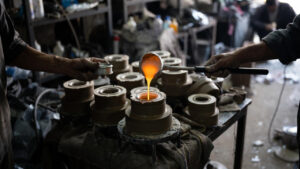
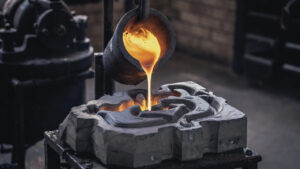
Metal (Stainless 304/316, Carbon Steel, Alloy Steel) is melted in a medium-frequency induction furnace. Pouring occurs at 1580–1600°C into the pre-heated shells within 30 seconds of removal from the kiln.
- Key Control: Low temperatures cause “misruns” (incomplete fill); high temperatures lead to severe oxidation.
Step 6: De-shelling (Shell Removal)
Once cooled, the ceramic shell is removed using vibratory machines and pneumatic hammers.
- Key Control: Careless handling can chip edges or cause stress cracks in the metal.
Step 7: Shot Blasting
Components undergo vertical shot blasting (4–6 bar) using 0.6–0.8 mm steel grit to remove oxides, followed by horizontal blasting for a uniform finish.
Step 8: Cut-off
Individual parts are removed from the central sprue (tree) using abrasive saws or plasma cutters.
Step 9: Grinding & Finishing
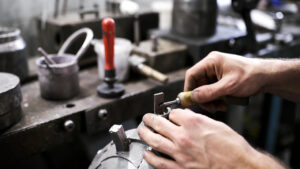
Gate stubs and weld lines are manually or CNC-ground. Dimensions are verified using 3D calipers.
- Key Control: Avoid over-grinding, which thins the walls and reduces structural integrity.
Step 10: Final Pickling & Cleaning
A closed-loop cleaning process:
- Acid Pickling: Immersion in $HNO_3 + HF$ solution.
- High-pressure rinsing: Water spray to remove chemicals.
- Drying: 80–100°C.
- Result: Final surface finish $Ra \leq 3.2$ µm.
Summary Table: The 10-Step Process Parameters
| Step | Process | Temp (°C) | Duration | Equipment | Primary Defect Risk |
| 1 | Wax Injection | 60–70 | 5–10s | 10–16T Press | Shrinkage, Deviation |
| 2 | Shell Building | Ambient | 24–48h | Slurry tanks/Sander | Cracking, Porosity |
| 3 | Dewaxing | 150–180 | 15–20m | Steam Autoclave | Wax residue, Inclusions |
| 4 | Burnout | 1000–1250 | 35–60m | Electric Kiln | Brittle shells |
| 5 | Pouring | 1580–1600 | 40m (melt) | Induction Furnace | Oxidation, Misruns |
| 7 | Shot Blasting | Ambient | 5–15m | Blasting machine | Surface deformation |
| 10 | Cleaning | 80–100 | 15–25m | Pickling tanks | Residual acid, Rust |
Quality Control & Business Benefits
Under ISO 9001:2015, CDL monitors every stage via continuous thermocouple logging and spectrometer analysis before every pour.
Proven Results:
- Scrap rate < 3%.
- 95–98% wax recycling efficiency.
- 30–50% reduction in post-cast machining costs.
Conclusion
Investment Casting at Lostwaxcasting CDL is the perfect blend of engineering precision and modern quality control. By strictly adhering to these 10 steps, we transform your ideas into “Precise – Durable – Optimized” products.
Contact us today for a free technical consultation based on your 3D drawings.