In the food, pharmaceutical, and sanitary sectors, stainless steel components must not only provide mechanical durability but also meet stringent hygienic standards: smooth surfaces, zero contamination, resistance to Clean-In-Place (CIP) acid washes, and compliance with FDA, HACCP, NSF, and EHEDG regulations.
At CDL LOST WAX CASTING JOINT STOCK COMPANY (Dong Nai) – an ISO 9001:2015 certified facility with a 60-ton/month capacity – we specialize in high-precision casting of SS 304 and 316. This article shares our specialized technical insights into material selection, process optimization, and surface finishing to achieve $Ra \leq 3.2$ µm (down to 0.8 µm), ensuring absolute safety for food and medical applications.
1. Why Stainless Steel 304 and 316 are Preferred?
- SS 304: Cost-effective with high ductility; ideal for components not in direct contact with food or for use in dry, mildly corrosive environments (freshwater, food oils).
- SS 316/316L: Contains 2–3% Molybdenum, providing 3–5x higher resistance to chlorides and acids than 304. This is the industry standard for direct-contact components (valves, fittings, mixers, gas appliance parts).
CDL Recommendation: Use SS 316L for all components in direct contact with dairy, beverage, and pharmaceutical products to eliminate the risk of pitting corrosion.
2. Industry-Specific Requirements
Casting for these sectors must strictly adhere to:
- Surface Roughness: $Ra \leq 3.2$ µm (with many clients requiring $\leq 1.6$ µm or $0.8$ µm).
- Defect Control: Zero tolerance for gas porosity, inclusions, or shrinkage (verified by 100% Dye Penetrant Inspection).
- Chemical Resistance: Must withstand CIP cleaning agents (Nitric acid, Caustic soda).
- Certifications: Full Mill Certificates and COA (Certificate of Analysis) complying with FDA 21 CFR 177.2600 and NSF/ANSI 61.
3. Specialized Casting Techniques at CDL
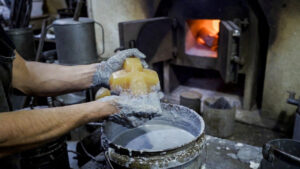
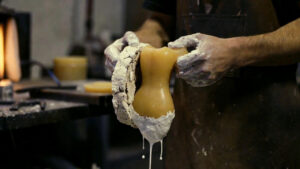
Step 1–2: Pattern Injection & Shell Building
- Using high-grade wax to minimize pattern shrinkage.
- Prime Coat: Utilizing 200–325 mesh Zircon to ensure a superior “as-cast” surface finish.
- Building 12–14 layers for a shell thickness of 9–11 mm to ensure thermal stability.
Step 3–4: Dewaxing & Burnout
- Dewaxing: 170°C at 7 bar for 16–18 minutes. Precise timing is critical to prevent residual wax—a primary cause of inclusions.
- Burnout: 1100–1180°C (depending on grade) with a strict $\pm$8°C tolerance to prevent oxidation and shell distortion.
Step 5: Precision Pouring
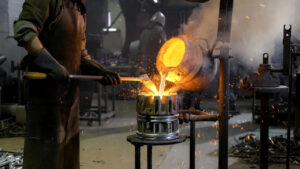
- Pouring Temp: 1580–1595°C.
- Deoxidation: Adding 0.15–0.25% deoxidizing agents to eliminate sub-surface porosity.
- Atmospheric Control: Minimizing oxide entrapment during the pour.
Step 8–10: 5-Step Sanitary Cleaning Process
Every casting at CDL for these industries undergoes a specialized cleaning cycle:
- Chemical Pickling: $HNO_3 + HF$ to remove all scale.
- Neutralization: Stabilizing the surface pH.
- High-Pressure Rinsing: (Ultrasonic cleaning available for complex internal geometries).
- Double Rinse: Using purified water.
- Thermal Drying: 95–105°C to eliminate moisture.
4. Technical Comparison: SS 304 vs. 316/316L
| Criterion | SS 304 | SS 316/316L (Recommended) |
| Chloride Resistance | Moderate | Excellent |
| Achievable Roughness ($Ra$) | 3.2–4.5 µm | 2.5–3.2 µm |
| Optimal Pouring Temp | 1580–1590°C | 1585–1600°C |
| Scrap Rate (Typical) | 4–7% | 2–3.5% |
| FDA/HACCP Compliance | Limited | Excellent |
5. Proven Case Studies at CDL
- Case 1 – High-End Gas Components: Switched from SS 304 to SS 316L using a 13-layer shell process. Achieved $Ra$ 2.8 µm and passed 500-hour acid tests with zero rust.
- Case 2 – Dairy Fittings: Cast 8,000 units in SS 316L. Implemented 100% Dye Penetrant Testing and CMM measurement. Result: 0% rejection rate over 18 months and successful export to the EU.
- Case 3 – Hospital Sanitary Ware: Used SS 316 to withstand daily chlorine disinfection, preventing pitting corrosion common with lower grades.
Conclusion
Casting stainless steel for the food and pharmaceutical sectors is a precise science that balances Investment Casting accuracy with high-end surface hygiene. SS 316L stands out as the optimal choice for these demanding environments.
With over 10 years of expertise and an ISO 9001:2015 framework, Lostwaxcasting CDL is your trusted partner for high-precision, FDA-compliant stainless steel solutions.