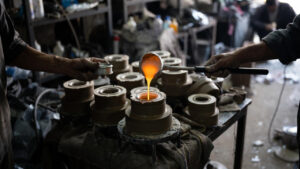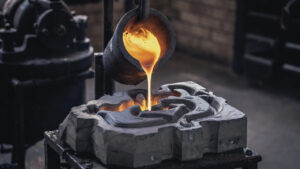
In Thin-shell Investment Casting (Lost Wax Casting), material selection and the optimization of mold preheat and pouring temperatures are the two critical factors determining 70–80% of final product quality. A deviation of just 20–30°C can trigger severe oxidation, inclusions, porosity, shrinkage, or hot tearing—causing scrap rates to skyrocket from 2–3% to 15–20%.
At CDL LOST WAX CASTING JOINT STOCK COMPANY (Dong Nai) – an ISO 9001:2015 certified facility with a 60-ton/month capacity – we have optimized these processes through thousands of production heats for stainless steel, carbon steel, alloy steel, and non-ferrous metals. Results: 98% mechanical property accuracy, surface finish $Ra \leq 3.2$ µm, and temperature-related scrap rates < 1.5%.
This article analyzes common materials, the mechanisms of mold preheating (1000–1250°C) and pouring (1580–1600°C), alongside comparative data and practical expertise from our foundry.
1. Common Metal Materials at CDL
CDL specializes in four main material groups, each requiring specific thermal profiles for optimal mechanical properties.
- 1.1 Stainless Steel 304 & 316 (Austenitic)
- Composition: 18–20% Cr, 8–14% Ni, 2–3% Mo (316).
- Applications: Marine components, gas stove parts, plumbing fittings (corrosion-resistant).
- Characteristics: High tensile strength (515–620 MPa).
- Shrinkage: 2.0–2.5% (Typical: 2.2–2.5%).
- 1.2 Carbon Steel (AISI 1020, 1045)
- Applications: Mechanical parts, gears, machine bases.
- Characteristics: Cost-effective, high machinability, tensile strength 400–600 MPa.
- Shrinkage: 1.6–2.0% (Typical: 1.8%).
- 1.3 Alloy Steel (4140, 4340, Duplex)
- Applications: Boat propellers, high-stress automotive and aerospace components.
- Characteristics: Tensile strength up to 900–1200 MPa, excellent wear resistance.
- Shrinkage: 1.3–1.7%.
- 1.4 Non-Ferrous Metals (Copper & Aluminum)
- Copper: 3–5% shrinkage, used for electrical components.
- Aluminum: Lightweight, corrosion-resistant parts.
2. Optimizing Mold Preheat (Burnout) Temperatures (1000–1250°C)
Preheating ensures complete wax removal and strengthens the ceramic shell.
- Recommended Settings:
- Stainless Steel 304/316: 1100–1180°C (Dwell: 40–50 mins).
- Carbon Steel: 1050–1150°C (Dwell: 35–45 mins).
- Alloy Steel: 1150–1250°C (Dwell: 50–60 mins).
- Mechanisms: Temperatures below 1000°C leave wax residue, causing porosity and inclusions. Over 1250°C makes the shell brittle, risking run-outs.
- CDL Practice: We use automated electric kilns with $\pm$5°C thermocouple accuracy. For SS316, firing at exactly 1150°C reduces inclusions by 95%.
3. Optimizing Pouring Temperatures (1580–1600°C)
Pouring heat directly affects fluidity, solidification, and surface defects.
- Recommended Settings:
- Stainless Steel 304/316: 1580–1600°C (Melt time: 40 mins).
- Carbon Steel: 1550–1580°C.
- Alloy Steel: 1600–1620°C (Argon shielding recommended).
- Mechanisms: Low pouring heat (<1550°C) leads to “misruns” (incomplete fill) and wavy surfaces. Excessive heat (>1620°C) increases gas solubility and dross/oxidation.
- CDL Practice: Transfer time from furnace to mold is kept $\leq$ 25–30 seconds to maintain thermal stability.
4. Comparative Material & Temperature Table
| Material | Shrinkage (%) | Preheat Temp (°C) | Preheat Time (min) | Pouring Temp (°C) | Primary Defects (if incorrect) |
| SS 304/316 | 2.2–2.5 | 1100–1180 | 40–50 | 1580–1600 | Inclusions, Oxidation |
| Carbon Steel | 1.6–2.0 | 1050–1150 | 35–45 | 1550–1580 | Shrinkage, Rough surface |
| Alloy Steel | 1.3–1.7 | 1150–1250 | 50–60 | 1600–1620 | Hot tearing, Porosity |
| Copper | 3.0–5.0 | 950–1050 | 30–40 | 1150–1250 | Significant shrinkage |
| Aluminum | 4.0–6.0 | 900–1000 | 25–35 | 680–750 | Severe oxidation |
5. Practical Solutions to Prevent Defects at CDL
- Spectrometer Pre-Pour Analysis: Verifies chemical composition and dissolved gases.
- Continuous Thermocouple Logging: Mandatory ISO 9001 temperature logs for every heat.
- Moldflow Simulation: Predicts “hot-spots” to adjust riser and gating placement.
- Inert Gas Shielding: Argon shielding for alloy steel reduces oxidation by 90%.
- Post-Cast Inspection: 100% Dye Penetrant and Tensile Testing for export batches.
Conclusion
Managing temperatures between 1000–1250°C (preheat) and 1580–1600°C (pouring) is the “heartbeat” of the Investment Casting process. Lostwaxcasting CDL has successfully applied these standards for major partners like THACO, Yamaha, Hyundai, and Ford.
If you are designing components or looking to optimize your production line, contact us for a free technical analysis. We provide precise parameters within 24 hours to ensure reduced scrap and maximized productivity.