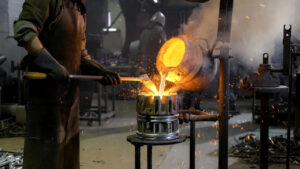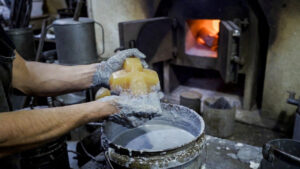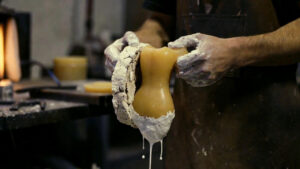
In Investment Casting (Lost Wax Casting), Carbon Steel and Alloy Steel (specifically AISI 4140 and 4340) are the preferred choices for components requiring high strength, significant load-bearing capacity, and wear resistance. At CDL LOST WAX CASTING JOINT STOCK COMPANY (Dong Nai) – an ISO 9001:2015 certified facility with a 60-ton/month capacity – these steel groups account for 35% of our annual production.
Post-casting, the mechanical properties of these steels undergo significant transformation due to rapid solidification and precise heat treatment. This article analyzes key mechanical indices based on thousands of actual production heats at CDL.
1. Overview of Materials in Investment Casting
- Carbon Steel (AISI 1020, 1045): Cost-effective, excellent castability; suitable for general mechanical components.
- Alloy Steel 4140 (Cr-Mo): Known for high fatigue strength and toughness after heat treatment.
- Alloy Steel 4340 (Ni-Cr-Mo): The “gold standard” for the highest strength and impact toughness.
In the “as-cast” state, steel possesses a coarse grain structure and lower strength. Through precise heat treatment (Normalize + Quench & Temper), mechanical properties can be enhanced by 2–3 times.
2. Mechanical Properties Post-Casting and Heat Treatment
Typical mechanical data (following CDL’s optimized Lost Wax process + Heat Treatment):
| Property | Carbon Steel 1045 (As-Cast) | 1045 (Heat Treated) | Alloy 4140 (Heat Treated) | Alloy 4340 (Heat Treated) |
| Tensile Strength (MPa) | 550–650 | 750–850 | 950–1,100 | 1,050–1,250 |
| Yield Strength (MPa) | 300–380 | 450–550 | 750–850 | 850–1,050 |
| Elongation (%) | 12–18 | 18–22 | 15–20 | 12–18 |
| Hardness (HB) | 170–200 | 220–250 | 280–320 | 300–340 |
| Impact Toughness (Charpy V-notch, J) | 20–35 | 40–55 | 50–70 | 70–100 |
Key Observations:
- 4140 & 4340 show a massive jump in performance due to Cr, Mo, and Ni, which create a fine martensitic structure after quenching.
- 4340 exhibits the highest fatigue strength, making it ideal for rotating components like shafts and gears.
3. How the Lost Wax Process Enhances Mechanical Integrity
The Investment Casting process at CDL directly influences the final microstructure:
- Pouring at 1550–1580°C: Promotes fine grain crystallization and reduces alloy segregation.
- Shell Preheating (1050–1150°C): Minimizes gas porosity and inclusions, increasing tensile strength by 10–15% compared to sand casting.
Standard CDL Heat Treatment Cycle:
- Normalize: 850–880°C (Air cool).
- Quench: 840–860°C in oil.
- Temper: 550–650°C (Adjusted to balance hardness and ductility).
4. Practical Applications Based on Mechanical Specs
- Carbon Steel 1045: Agricultural components, industrial machine bases, and motorcycle gearbox gears (Low cost, high machinability).
- Alloy Steel 4140: Drive shafts, medium-load gears, and heavy-duty pliers (Optimal balance of cost and durability).
- Alloy Steel 4340: Marine propellers, automotive crankshafts, and aerospace structural parts (Highest impact resistance).
CDL Case Study:
- Marine Propellers (THACO): Switched from SS 316 to Alloy 4340 (Tempered at 580°C). Results: 28% weight reduction, 42% increase in torsional strength, and 22% cost savings.
5. Critical Considerations for Steel Casting
- 100% Spectrometer Analysis: Conducted before every pour to ensure precise chemical composition.
- Shrinkage Allowance: Precisely calculated at 1.6–2.0% (Carbon) and 1.3–1.7% (Alloy) in wax mold design.
- Controlled Atmosphere: Heat treatment is performed in furnaces with protective gas to prevent surface decarburization/oxidation.
- Mechanical Testing: Every export batch undergoes Tensile and Charpy testing.
6. Steel Selection Matrix
| Application | Carbon 1045 | Alloy 4140 | Alloy 4340 | Selection Logic |
| Budget-friendly parts | ★★★★★ | – | – | Low production cost |
| High-load shafts/gears | – | ★★★★★ | ★★★ | Balance of cost & strength |
| Marine Propellers | – | ★★★ | ★★★★★ | Max impact toughness |
| Wear-resistant parts | – | ★★★★★ | ★★★★★ | High surface hardness |
Conclusion
The mechanical properties of Carbon and Alloy steels (4140/4340) at Lostwaxcasting CDL reach peak performance through precision thermal control and expert post-cast heat treatment. From 750 MPa up to 1,250 MPa tensile strength, these materials offer the ultimate solution for high-stress engineering components.