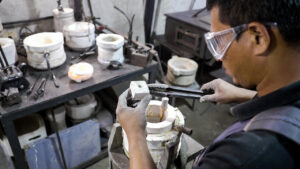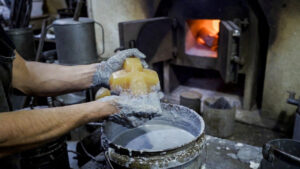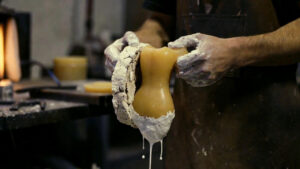
In extreme environments such as offshore oil and gas, marine engineering, chemical processing, and wastewater treatment, standard Austenitic stainless steels (304/316) often fail to meet the required service life. This is why Duplex 2205 and Super Duplex 2507 have become the optimal choices in Investment Casting (Lost Wax Casting).
At CDL LOST WAX CASTING JOINT STOCK COMPANY (Dong Nai) – an ISO 9001:2015 certified specialist – these Duplex grades account for an increasing share of our export projects. With a dual-phase microstructure (Austenite + Ferrite) and a PREN index of 40–45, Duplex grades offer 5–10 times the resistance to pitting and crevice corrosion compared to 316L, while maintaining superior mechanical strength.
1. Chemical Composition – The Foundation of Corrosion Resistance
| Element | Duplex 2205 | Super Duplex 2507 | SS 316L (Comparison) |
| Cr (%) | 21.0–23.0 | 24.0–26.0 | 16.0–18.0 |
| Ni (%) | 4.5–6.5 | 6.0–8.0 | 10.0–14.0 |
| Mo (%) | 2.5–3.5 | 3.0–5.0 | 2.0–3.0 |
| N (%) | 0.08–0.20 | 0.24–0.32 | $\leq$ 0.10 |
| PREN | 35–36 | 40–45 | 24–26 |
PREN (Pitting Resistance Equivalent Number) $= \%Cr + 3.3 \times \%Mo + 16 \times \%N$.
With a PREN up to 45, Super Duplex 2507 can withstand harsh chlorides and strong acids at temperatures up to 350°C.
2. Mechanical Properties Post-Investment Casting
Following Solution Annealing (1020–1100°C) and rapid quenching, Duplex grades achieve:
| Property | Duplex 2205 | Super Duplex 2507 | SS 316L |
| Tensile Strength (MPa) | 620–750 | 800–1,000 | 550–700 |
| Yield Strength (MPa) | 450–550 | 550–700 | 220–290 |
| Hardness (HB) | 250–290 | 280–320 | 160–190 |
| Fatigue Strength (MPa) | ~450 | ~520 | ~320 |
Duplex provides 1.5–2x the strength of 316L while maintaining high ductility, making it ideal for high-load components such as marine propellers and high-pressure valves.
3. Specialized Duplex Casting Techniques at CDL
Duplex is more challenging to cast than Austenitic steel due to the risk of Sigma Phase formation (which causes brittleness) if cooling is not strictly controlled.
- Shell Building: 13–15 layers with a superfine Zircon prime coat to control the 1.4–1.7% shrinkage rate.
- Burnout: 1080–1120°C with a controlled thermal ramp of 5°C/min.
- Precision Pouring: 1560–1580°C under Argon shielding to prevent oxidation.
- Post-Cast Heat Treatment: Solution Annealing at 1050–1080°C followed by an immediate Water Quench to dissolve any harmful Sigma phases.
- Phase Verification: 100% testing using a Ferritscope to ensure the ideal 35–55% Ferrite ratio.
4. Comparative Service Life
| Environment | SS 316L | Duplex 2205 | Super Duplex 2507 |
| Seawater (Chloride) | Good | Excellent | Superior |
| $H_2S$ (Oil & Gas) | Not Recommended | Good | Best |
| Estimated Lifespan | 5–8 years | 15–25 years | 25–40 years |
5. Proven Case Studies at CDL
- Case 1 – Marine Propellers (THACO Marine): Switched from SS 316L to Duplex 2205. Results: Lifespan increased 4x, component weight reduced by 15%, and total replacement costs dropped by 60%. Certified by ABS/DNV.
- Case 2 – Offshore Oil & Gas Valves: Cast 1,200 units in Super Duplex 2507. Achieved a PREN of 42 and successfully withstood 5% $H_2S$ concentrations at 120°C without corrosion.
- Case 3 – Wastewater Treatment: Replaced plated carbon steel with Duplex 2205, extending maintenance intervals from 1 year to 5 years, saving 70% in operational costs.
6. Critical Recommendations
- Select Duplex when PREN >30 is required (chlorides >500 ppm).
- Always verify the phase balance post-casting to ensure the correct Austenite-Ferrite ratio.
- Utilize Moldflow simulations to optimize the tree design and minimize shrinkage voids.
- ROI Factor: While initial material costs are 25–35% higher than 316L, the Return on Investment is typically realized within 2–3 years through reduced downtime.
Conclusion
Duplex 2205 and Super Duplex 2507 are the definitive solutions for corrosive environments in Investment Casting. At Lostwaxcasting CDL, our rigorous ISO 9001:2015 process and 100% Ferrite testing ensure your components are Ultra-Durable – Corrosion-Resistant – Cost-Optimized.